

24VAC Thermostats for North American Systems
Four body styles, one 24VAC platform. On this page the differences are the point: which model accepts how many sensors, which one drives humidity equipment, which backplate fits an existing wall box — and which connectivity build you need. Wi-Fi ships as standard; MQTT, ZigBee and Matter are custom orders, and the MQTT build has already shipped on the PCT513-W.
Four connectivity builds, one thermostat platform
The model number tells you the body and the feature set. The build tells you where the data goes, and that usually decides the project before the spec sheet does.
Already delivered: PCT513-W on MQTT
The MQTT build of the 513-W publishes to a broker you host — local server or private cloud — with no Tuya account and no vendor cloud in the path. It is the answer when the requirement is "the data cannot leave the building".
| Build | Status | Where the data goes | Choose it when |
|---|---|---|---|
| Wi-Fi (Tuya) | Standard, in production | Tuya Cloud, controlled from the Smart Life app | Retail, apartments and quick deployments where an app is enough |
| MQTT | Custom order — already delivered on the PCT513-W | Your own broker, local or private cloud. No vendor cloud in the data path. | Integrators building their own dashboard or BMS, and projects where data cannot leave the site |
| ZigBee | Custom order | A ZigBee gateway — ours or a third-party one | Sites that already run a ZigBee mesh, or where Wi-Fi credentials cannot be handed out |
| Matter | Custom order | A local Matter controller, no manufacturer account | Cross-ecosystem projects — Apple Home, Google Home, Alexa and Home Assistant on one device |
Custom builds are quoted per project: the constraint is firmware scope and lead time, not the hardware. Tell us the broker or controller, the payload format and the commands you need, and we answer with a build spec rather than a brochure.
The four models, and what actually separates them
2H/2C conventional, 4H/2C heat pump and dual fuel are identical across all four — repeating them in every row adds nothing. What follows are the rows that change an order.
| What differs | PCT513 | PCT523 / 5231 | PCT533 | PCT533C |
|---|---|---|---|---|
| Remote sensors 915 MHz, not interchangeable with other sensor types | 16 | 9 | 6 | none |
| Occupancy What the thermostat uses to decide nobody is home | PIR, 3 m / 70° | Radar, optional | Radar, standard | none |
| Humidifier / dehumidifier Dedicated ACC1 / ACC2 terminals, 1-wire or 2-wire | none | none | ACC1/ACC2 | none |
| Front panel | 4.3" touch, 480×272 | PCT523: black screen + buttons; PCT5231: LED segment | 4.3" touch, 480×800 | 4.3" touch, 480×800 |
| Wall box Retrofit without cutting a new opening | standard | PCT5231: 83.3 mm | standard | standard |
| Freeing a wire at the wall For a three-wire wall that needs a second heating stage | S terminal: Y and G share one conductor | needs SWB511 adapter | needs SWB511 adapter | needs SWB511 adapter |
| On-screen languages English / French / Spanish / Chinese | English | English | 4 languages | 4 languages |
The same features measured against Sensi, Honeywell, Nest, Ecobee, Amazon and Meross — 22 thermostats in three price bands — are in the cross-brand comparison.
The four bodies — and the 533U that is coming
The 523, 533 and 533C are the current generation and the ones worth quoting on a new project. The 513 stays in the range because nothing else accepts 16 sensors, and the 5231 because of its 83.3 mm backplate. The 533U is the next release.
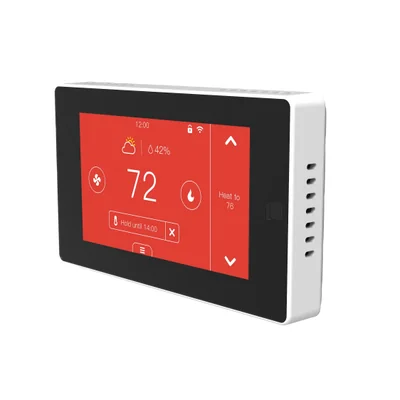
PCT513
The sensor model
Up to 16 remote zone sensors on 915 MHz, and an S terminal that lets Y and G share one conductor, so a three-wire wall can carry a second stage without an adapter.
- 16 sensors
- PIR 3 m / 70°
- 4.3" 480×272
- S terminal
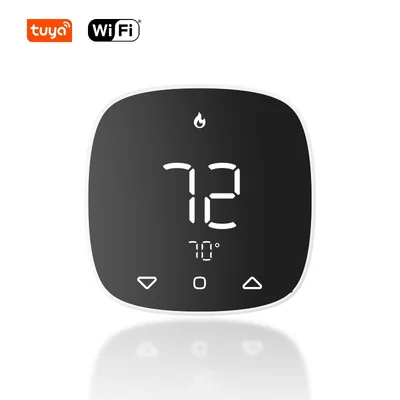
PCT523 / 5231
The retrofit model
One platform in two bodies: the PCT523 has touch buttons and a black screen, the PCT5231 has an LED segment display and a backplate that lands on 83.3 mm junction boxes without a new hole.
- 9 sensors
- Radar optional
- 83.3 mm box
- 7-day fan schedule
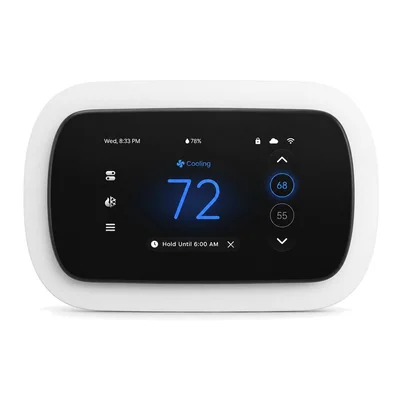
PCT533
The humidity model
The only model in the range with ACC1/ACC2 terminals, so it can drive a humidifier or a dehumidifier. Radar occupancy is standard, and the screen is 480×800.
- 6 sensors
- ACC1/ACC2
- Radar standard
- 4.3" 480×800
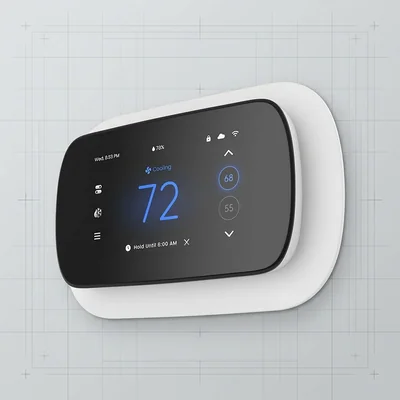
PCT533C
The core model
The same 4.3-inch platform as the 533 with the three features a hotel room or a rental rarely needs removed: remote sensors, humidity outputs and occupancy sensing.
- No sensors
- No humidity
- No occupancy
- 480×800
Coming before the end of 2026
PCT533U — the 533 with air-quality control
Everything the 533 does, plus VOC and CO2 sensing, ERV/HRV damper control, multi-speed fan control and fresh-air control. None of those exist on the 533 or the 533C. If a project needs them, model the 533U now rather than fitting a 533 and adding a separate controller later.
Three wires, four wires, or the S terminal
The wall usually has three conductors: Y/Y1, G and R (or Rc or Rh). That is enough to run any model on this page — with the SWB511 C-Wire Adapter, which builds a permanent supply from the fan circuit. If a W wire is present as well, connect it too and the second heating stage survives.
The 513 has a second route: its S terminal lets Y and G share one conductor, which frees a wire without adding an adapter. That is the cheapest way to keep a second stage on a genuinely three-wire wall, and it is the one specification difference most buyers miss.
What this range does not do
- • 2-wire systems
- • Baseboard heaters
- • 3-stage conventional heating
- • Systems at 120V or higher
- • Thick wires with wire nuts
Three more limits belong to this range, not to OWON:
Looking for the 230V or ZigBee models?
This page is the 24VAC North American line on its standard builds. The 230V European models, the ZigBee thermostat range and the fan coil range are in the catalogue.
See all thermostat familiesCommon questions
Can I get an MQTT version instead of the Tuya cloud?
Yes. The PCT513-W has already shipped in an MQTT build: the thermostat publishes to your own broker instead of the Tuya Cloud, so there is no vendor account and no cloud round-trip. The same customisation can be quoted for the other models on this page — tell us the broker, the payload format and whether you need TLS with client certificates.
Can you supply ZigBee or Matter versions of these thermostats?
Both are custom orders rather than catalogue items. The ZigBee build joins a ZigBee gateway, ours or a third-party one; the Matter build is controlled from a local Matter controller without a manufacturer account. Lead time, firmware scope and MOQ are quoted per project, so the useful first step is a short description of your gateway and the commands you need.
What does the PCT533U add, and when is it available?
The PCT533U is the air-quality variant of the 533 and is scheduled for release before the end of 2026. It adds VOC and CO2 sensing, ERV/HRV damper control, multi-speed fan control and fresh-air control on top of what the 533 already does. The 533 and 533C do not have those functions; if one of them is the reason you are buying, the 533U is the model to wait for.
PCT513 or PCT523 — which one for a house with uneven rooms?
The 513 if the problem is temperature differences between rooms: it accepts 16 sensors against 9 on the 523, and its S terminal can free a conductor on a three-wire wall. The 523 if you want a cheaper panel, touch buttons instead of a touchscreen, or the 83.3 mm backplate that replaces an old thermostat without a new opening.
Which model can control a humidifier or dehumidifier?
Only the PCT533. It has dedicated ACC1 and ACC2 terminals and supports 1-wire or 2-wire humidifier and dehumidifier wiring. The 513, 523 and 533C have no HUM or DEHUM output, and no adapter adds one.
Do all four work on a heat pump with auxiliary heat and dual fuel?
Yes. All four do 2H/2C conventional and 4H/2C heat pump, including auxiliary or emergency heat and dual-fuel switching between a heat pump and a gas furnace. The differences between them are sensors, humidity, occupancy and the front panel, not what they can switch.
Are the 230V European models on this page?
No. This page is the 24VAC North American line. The 230V European models and the ZigBee thermostat range are listed in the full catalogue.
Need a build, not a catalogue model?
Send the broker or controller you are integrating with, the wires at the wall, and the model you are considering. You get back a build spec — connectivity, terminals, lead time — rather than a datasheet you have to interpret.